
Are We Recruiting the Right Drivers?
Recruiting a professional driver usually involves a number of important checks.
- Does the candidate hold the correct licence?
- Are their qualifications current?
- Do they have the necessary experience?
- What does their employment history look like?
- Can they demonstrate adequate vehicle control during a practical driving assessment?
All of these checks matter. However, they may not tell us everything about how that person identifies, anticipates and responds to risk on the road. Human error contributes to the vast majority of road traffic collisions. This makes the ability to identify, anticipate and respond to hazards one of the most important skills a professional driver can possess. Yet this is often one of the least directly assessed parts of the recruitment process.
Two candidates could hold the same licence, have similar qualifications and a similar number of years behind the wheel – and, in the case of HGV, bus or coach drivers, hold the same Driver CPC. That does not necessarily mean they will notice the same hazards, make the same decisions or respond to developing situations in the same way.
So, should behavioural driver assessments play a greater role in recruitment?
Qualifications confirm eligibility, but not every aspect of competence
A valid driving licence confirms that someone has met the required standard to drive a particular class of vehicle. For professional lorry, bus and coach drivers, employers can also check their Driver CPC status and training record.
These checks provide essential information, but they largely tell an employer whether the candidate is legally qualified to undertake the role.
Employment history and references can provide further evidence of experience, reliability and previous performance. A practical assessment can then help establish whether the candidate can control the relevant vehicle, follow procedures and demonstrate appropriate driving techniques while being observed.
However, driving competence is broader than technical vehicle control.
It also involves recognising where risk is developing, identifying the early clues that another road user may behave unexpectedly and making appropriate decisions before a situation becomes critical.
These are cognitive and behavioural skills, and they can vary considerably between drivers. Hazard perception is a multifaceted skill. Drivers must know where to look, identify the early clues that suggest a hazard may develop, prioritise competing sources of information and continuously monitor the road ahead. Much of this process happens automatically, without conscious awareness, making it difficult to assess through interviews or discussions alone.

Practical assessments provide valuable insight into vehicle control and driving technique, but may not reveal every aspect of how a candidate processes developing risk.
Experience does not always equal hazard anticipation
Experience is valuable, but the number of years someone has held a licence does not provide a direct measure of how well they anticipate hazards.
One experienced driver may continually scan the road ahead, notice subtle behavioural clues and adjust early. Another may react only when the danger becomes obvious.
Research into hazard perception has shown that the skill generally improves with driving experience ( The Science of Hazard Perception: Fleet Competency Series Guide 6 ). However, experience alone does not guarantee strong hazard anticipation, and drivers with a similar number of years behind the wheel can perform very differently. The skill can also be developed through training and is associated with collision involvement.
This evidence contributed to hazard perception becoming part of the UK driving theory test in 2002 ( Hazard perception assessment & training for young, novice drivers ).
Our own research has explored this further through hazard prediction ( Hazard Perception for Identifying Risk in Professional Drivers ).
What does a hazard prediction assessment measure?
Rather than asking someone to respond once a hazard is already developing, a hazard prediction assessment examines whether the driver has understood the earlier clues within the scene.
The footage stops as the situation begins to unfold and the driver is asked what happens next. This provides objective insight into whether they were monitoring and interpreting the relevant information before the hazard fully emerged.
The driver watches a realistic road scene
The footage stops as the situation begins to unfold
The driver is asked what happens next
Their understanding of the developing hazard is assessed
Because the assessment focuses on whether the driver has recognised the developing situation rather than simply reacting quickly, it removes some of the ambiguity associated with traditional button-response hazard perception tests and provides an objective measure of whether the driver has correctly interpreted the road scene.
In our own research involving professional fire-appliance drivers ( Hazard Perception for Identifying Risk in Professional Drivers ), hazard prediction performance distinguished between experienced drivers with different risk histories. Lower-risk experienced drivers were better able to predict what would happen next and were more likely to monitor the relevant precursors to the hazard than high-risk drivers.
That matters because recruitment processes should ideally help organisations understand more than whether a candidate can react correctly during one observed drive.
They should also help identify how the candidate processes risk, recognises developing hazards and makes decisions before a situation becomes critical.
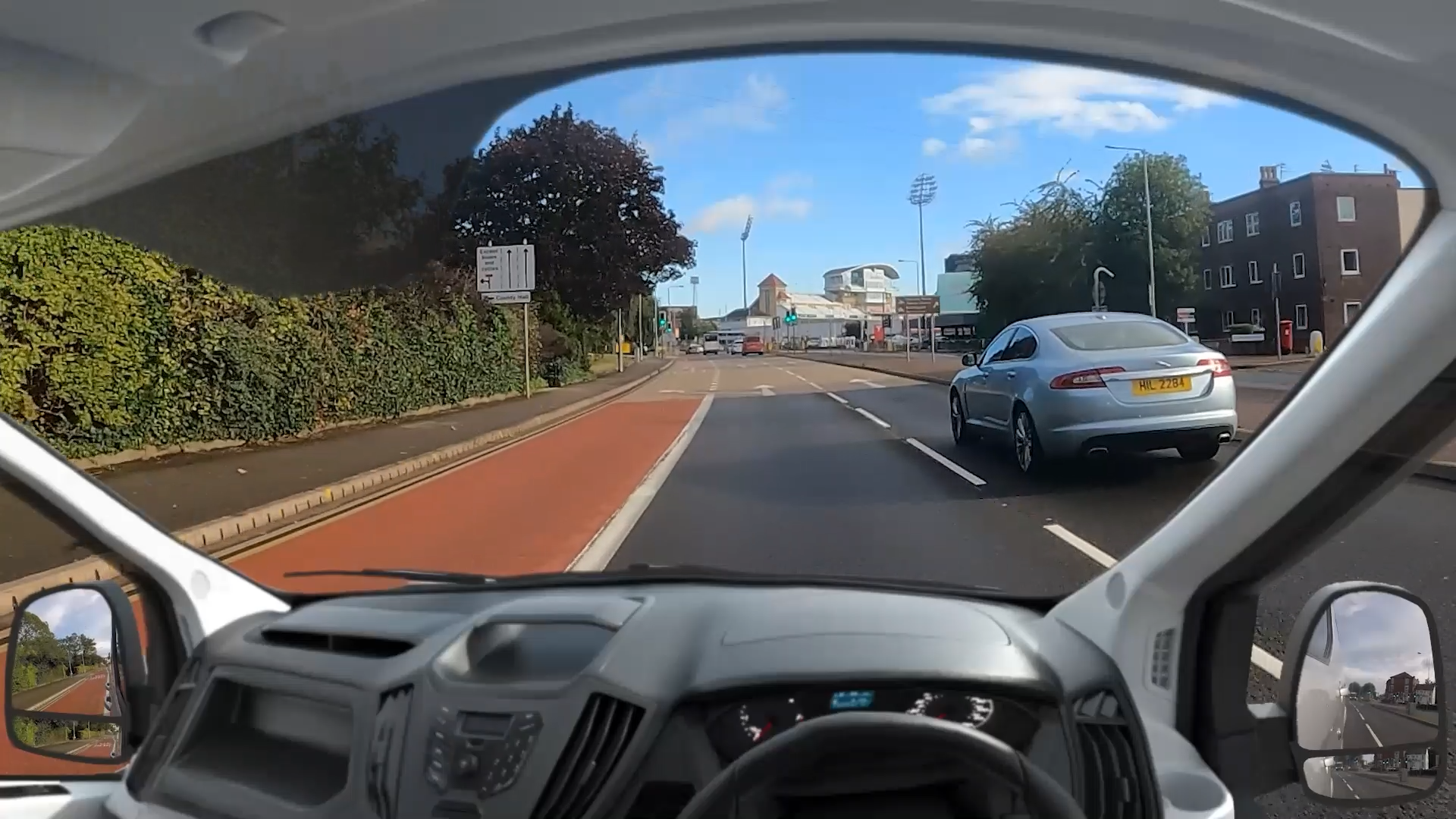
Hazard prediction assesses whether a driver has identified and interpreted the earlier clues within a developing road situation.
Adding behavioural insight to driver recruitment
Behavioural assessments could provide an additional source of objective evidence to support recruitment decisions ( Online Driver Risk Assessment – Identify Driver Risk Factors ).
In fact, driver assessment has long been recognised as a valuable recruitment tool. A relatively small proportion of drivers are often responsible for a disproportionate number of fleet collisions. Identifying those drivers before they join an organisation has the potential to improve safety whilst reducing future operational costs.
Existing recruitment measures
- Licence and qualification checks
- References and employment history
- Interviews
- Medical or eyesight requirements
- Practical driving assessments
Additional behavioural insight
- Hazard perception
- Hazard anticipation
- Decision-making
- Responses to realistic road situations
- Attitudes towards driving risk
Behavioural assessments would not replace existing recruitment measures. Instead, they could complement them by providing consistent, objective insight into how a candidate interprets and responds to risk.
The Health and Safety Executive advises employers recruiting drivers to consider how they will assess competence before the individual starts work, rather than relying solely on certificates and qualifications.
A behavioural assessment gives the organisation another way to explore that competence. It could be completed by shortlisted candidates before a final interview, alongside a practical assessment or as part of the onboarding process once a provisional offer has been made.
The most appropriate point will depend on the organisation, the role and how the results will be used.
Recruitment should not simply be about passing or failing
The value of assessment is not limited to deciding whether to employ someone.
Results can also help an organisation understand how best to support a successful candidate.
For example, a candidate may demonstrate good vehicle control and strong professional experience but perform less well when predicting developing hazards. That does not necessarily mean the person should automatically be rejected. It may indicate that their induction should include additional hazard-awareness training, coaching or closer support during their first few months.
Another driver may perform well when anticipating hazards but show a greater willingness to accept risk. This could inform conversations during onboarding and help the organisation select appropriate development activities.
Used in this way, behavioural assessment can create a clearer connection between recruitment and ongoing driver development.
Rather than every new employee receiving exactly the same induction programme, organisations could instead use recruitment assessment to inform personalised development plans from day one. Drivers who demonstrate strong hazard awareness may require little additional support, whereas those who show specific weaknesses can receive targeted coaching before those weaknesses contribute to incidents on the road.
Supporting better-informed recruitment decisions
Recruitment decisions inevitably involve human judgement, particularly when assessing qualities such as awareness, anticipation and decision-making.
Interviews and observed drives can be valuable, but they can also be influenced by factors such as the assessor, the route, traffic conditions and how the candidate performs on that particular day.
Structured, job-relevant assessments can add consistency by allowing candidates to complete the same tasks and be assessed against the same criteria.
CIPD guidance recommends that skill-based recruitment assessments resemble the real role as closely as possible and form part of a clear, objective and transparent selection process.
For driver recruitment, this means using realistic road scenarios that are relevant to the types of vehicles candidates will operate.
An HGV driver faces different visual demands and road situations from a car or van driver. The assessment should reflect that, rather than relying on a generic personality or risk questionnaire that has little direct connection to the driving task.
This is particularly important because professional drivers operate in very different environments. The visual demands placed on an HGV driver differ considerably from those experienced by someone driving a car or van.
Assessments therefore need to reflect the vehicle, the role and the hazards that drivers actually encounter in their day-to-day work.
A responsible part of a wider decision
No individual test can tell an employer with certainty whether someone will be involved in a future collision. Driver behaviour is influenced by many factors, including experience, workload, fatigue, organisational culture, time pressure, vehicle condition and the driving environment.
Behavioural assessments should therefore be used as one part of a broader recruitment and risk-management process.
Organisations should be clear about what is being measured, explain the assessment to candidates and consider reasonable adjustments where appropriate.
Results should be interpreted carefully and linked to the requirements of the role.
The purpose should be to make better-informed and more consistent decisions, not to create an unsupported label of "safe" or "unsafe".
How Esitu supports evidence-based driver recruitment
Esitu's behavioural driver assessments are designed to complement existing recruitment and onboarding processes by providing objective insight into how drivers identify, anticipate and respond to hazards.
Rather than replacing practical driving assessments, interviews or qualification checks, behavioural assessments provide an additional layer of evidence that can help organisations make more informed decisions and identify where targeted development may be beneficial.
Hazard Perception
Understand how effectively drivers detect developing hazards within realistic driving situations.
Hazard Prediction
Assess whether drivers correctly interpret the behavioural clues that indicate what is likely to happen next.
Risk Taking
Explore attitudes towards risk to help identify behaviours that may benefit from additional coaching and support.
Together, these assessments provide organisations with objective behavioural information that can be used to support recruitment, identify training needs and create more personalised driver development programmes.
"Is this person qualified to drive?"
"How effectively does this person identify, anticipate and respond to developing risk?"
Looking beyond licences and experience
Qualifications, licences, employment history and practical assessments all have an important role in driver recruitment. They provide valuable information about whether someone is legally qualified, experienced and capable of operating a vehicle safely during an observed assessment.
However, they may not fully capture how a driver recognises developing hazards, interprets risk or makes decisions in complex traffic situations.
Behavioural assessments provide an opportunity to measure these skills objectively using realistic driving scenarios. Used alongside existing recruitment processes, they can help organisations make better-informed decisions, personalise onboarding and identify opportunities for targeted development before drivers begin working on the road.
As fleets increasingly seek to prevent collisions rather than simply respond to them, understanding driver behaviour before incidents occur may become an increasingly valuable part of evidence-based recruitment.
Discover how behavioural driver assessment can strengthen recruitment
Find out how Esitu's evidence-based hazard perception, hazard prediction and risk-taking assessments can support recruitment, onboarding and targeted driver development.
Explore Driver AssessmentsReady to discuss your requirements? Contact the Esitu team .